
The $1.7 Trillion
Truth Social
Trade
Three weeks ago we asked how high oil could go. This week the question is different: how much of the oil price is real supply shortage — and how much is a single man’s social media feed? The answer is both, which makes it almost impossible to trade and extremely dangerous to policy-make around.
Prices: Day 24, March 24, 2026
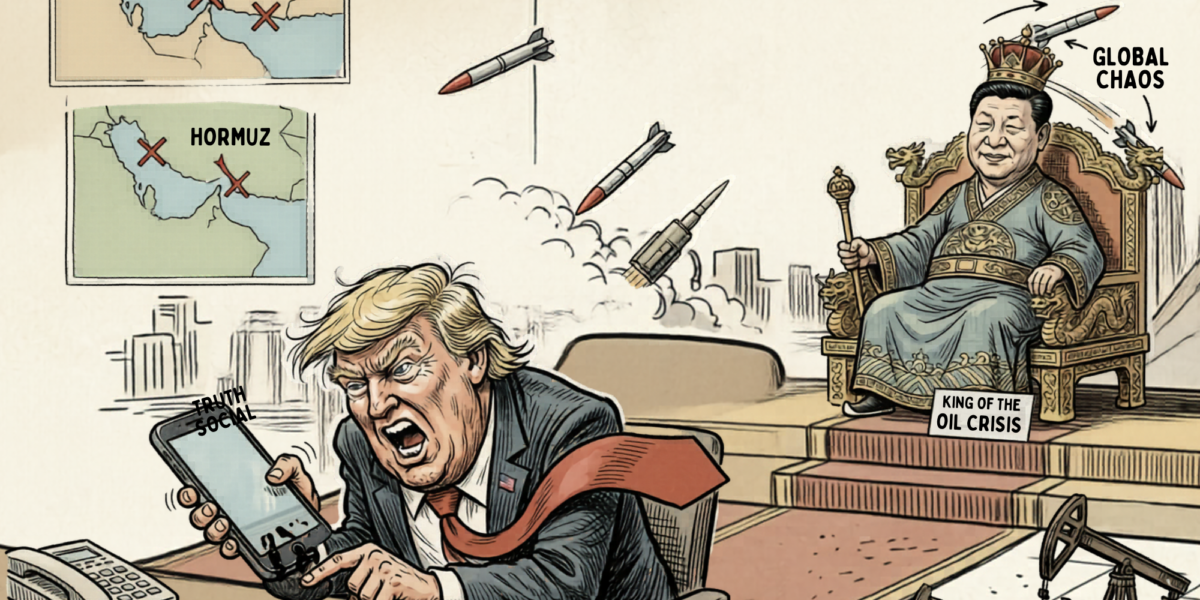
The $1.7 Trillion Tweet: Trump, Oil & the Pattern of Market Theater
On Saturday March 21, Trump issued a 48-hour ultimatum to Iran: reopen the Strait of Hormuz or the US would “hit and obliterate” Iran’s biggest power plant. Oil climbed toward $119. Monday morning, two hours before US markets opened, Trump posted in all-caps on Truth Social that the US and Iran had held “very good and productive conversations” toward a “complete and total resolution.” He ordered a five-day pause on strikes against Iranian power plants. Oil crashed 11–13%. Stocks added $1.7 trillion. Then Iran responded.
This is not the first time. CNN’s analysis documents a clear and “undeniable Trump pattern”: his announcements are consistently timed to market open and close windows. The Mar 23 post arrived exactly two hours before US equity markets opened. The 48-hour deadline was set to expire Monday evening — conveniently at the end of the energy sector’s trading week. Iranian analyst Seyed Mohammad Marandi wrote on X: “Every week, when markets open, Trump makes these kinds of statements to drive down oil prices. Even his five-day deadline aligns with the closure of the energy market.”
Fortune described the episode with blunt precision: “In the time it takes to walk from your car to your desk, President Donald Trump added $1.7 trillion to stocks and pushed the price of oil down by $17, or approximately 15%. By the time you got your coffee, Iran had reportedly called him a liar, and half those gains vanished. This is the average Monday morning for a very market-oriented executive in the fourth week of war.”
What makes this particularly significant from an energy market perspective is the $580 million in oil options bets reportedly placed approximately 15 minutes before Trump’s Truth Social post — documented by Investing.com. Whether this represents advance knowledge, algorithm sensitivity to weekend diplomatic chatter, or coincidence cannot be definitively established from public information. But the pattern is impossible to ignore: large directional oil options bets placed before a market-moving presidential statement, timed precisely for market open.
What Is Real vs. What Is Noise: A Six-Point Market Reality Check
With Trump’s statements regularly moving markets $10–17 per barrel only to reverse within hours, it is essential to separate durable physical realities from sentiment-driven noise. The following is our assessment of what is structural versus what is priced on words rather than facts.
The IEA Has Confirmed −10 Million bpd
The IEA’s March 2026 Oil Market Report — the most authoritative monthly oil market assessment in the world — confirms Gulf countries have cut total oil production by at least 10 million barrels per day. This is not an estimate or risk scenario. It is confirmed measured data. Global supply is projected to plunge by 8 million bpd in March alone. This is the largest supply disruption in the history of the global oil market — by the IEA’s own characterization.
Trump’s “Productive Talks” With Iran
Iran’s parliament speaker, foreign ministry, and state media have all denied direct negotiations occurred. The US White House did not initially respond to CNBC’s request for confirmation. Iran’s official position: messages have been received from intermediary countries — which is simply diplomatic routine — not negotiations. No date, no venue, no joint statement, no agreed framework. The Hormuz closure continues unchanged. The mines remain in place.
Reserves Are Being Depleted, Not Replenished
The 172 million barrels the US is releasing represents 41% of the entire 415-million-barrel Strategic Petroleum Reserve. The IEA release of 400 million barrels total represents approximately 10% of all IEA member emergency stockpiles. These reserves cannot be replenished quickly — it requires months to years and sustained low oil prices to refill. Energy Secretary Wright says the US plans to replace the released barrels “within a year at no cost to taxpayers” — a claim that becomes increasingly difficult if oil stays above $100.
Saudi/Red Sea Rerouting Is “Solving” the Problem
Saudi Arabia has diverted some crude via Yanbu (Red Sea). UAE’s Fujairah pipeline provides additional bypass. Combined, these alternatives can handle roughly 3–4 million barrels per day. Against the 20 million bpd that normally transits Hormuz, and the confirmed 10 million bpd supply loss, the bypass routes cover 15–20% of the gap at best. Saudi Arabia itself acknowledged 89% of its energy exports normally transit Hormuz. The Red Sea “solution” is real but deeply insufficient.
Demand Destruction Is Finally Underway
The IEA has cut its 2026 global demand growth forecast by 210 kb/d to just 640 kb/d total growth. More significantly, it has reduced March and April demand estimates by more than 1 million bpd versus prior forecasts — driven by flight cancellations across the Middle East (reducing jet fuel demand by 40% in the region) and LPG shortages forcing industrial and cooking gas substitution. At $100+ oil, the IEA is now advising consumers to work from home, drive slower, and avoid gas cookers. Demand destruction is real — but it only partially offsets the supply loss.
“Oil Will Drop Very Rapidly When This Is Over”
Trump’s repeatedly stated prediction that oil prices will fall rapidly post-conflict ignores the mine-clearance timeline (months), the insurance reinstatement process (weeks after incident-free period), the Qatar LNG restart lag (minimum one month of clean-up and recommissioning from day of ceasefire), and the refinery restart requirements at facilities like Ras Tanura (350K bpd, severely damaged). The supply restoration curve is measured in months, not days. Goldman Sachs projects Brent averaging $110 in March–April even in its base case.
The SPR Paradox: Burning Tomorrow’s Fire Extinguisher Today
The World Is Burning Through Emergency Reserves at a Rate That Cannot Be Sustained
IEA member nations hold approximately 1.25 billion barrels in government emergency reserves. The 400 million barrel release pledged on March 11 represents roughly 32% of that total — deployed against a crisis that the IEA itself says will not resolve without Hormuz reopening. The US component alone (172 million barrels) is 41% of the entire Strategic Petroleum Reserve. If the conflict continues beyond Q2 2026, member nations will face a choice: authorize a second emergency release from increasingly depleted reserves, or allow market prices to continue rising unconstrained. A second release would represent a systemic weakening of the Western world’s primary energy security buffer — built over decades and intended for exactly this kind of scenario.
The IEA’s own language has escalated significantly. IEA Executive Director Fatih Birol told reporters on March 23 that the Middle East situation is “very severe” and is worse than the two energy crises of the 1970s and the fallout of the Ukraine war “put together.” This is not market commentary — it is the head of the world’s leading energy security organization speaking on the record. The 1973 Arab Oil Embargo removed 4.4 million bpd and triggered a global recession. The 1979 Iranian Revolution removed approximately 5.6 million bpd and drove inflation to double digits across the West. The IEA is saying the current crisis exceeds both — simultaneously.
Meanwhile the IEA has published consumer guidance advising remote work, reduced driving, and avoiding gas cookers — advice last given during the 1973 crisis. These are not precautionary measures. They represent an acknowledgment that demand reduction has become a policy tool because supply-side solutions are insufficient.
Scenarios at Day 24: The “Trump Deal” Discount vs. Physical Reality
The Trump announcement introduced a new variable into scenario modeling that no analyst playbook has previously needed to price: a systematic pattern of market-moving presidential statements that are then flatly denied by the other party. Markets now need to assign probability not just to geopolitical outcomes but to how credibly Trump’s statements predict those outcomes. That is a function of credibility — which is measurably declining with each cycle of announcement, rally, denial, and reversal.
Genuine Deal + Mine Clearance
- A real — not announced — ceasefire materializes within 2 weeks
- Iran halts mine-laying; international clearance begins
- Hormuz commercially viable in 4–6 weeks post-ceasefire
- Qatar LNG restart announced (minimum 4–6 weeks from that date)
- SPR releases bridge gap during clearance period
- Price drops sharply on verified ceasefire — but floor is higher than pre-war due to structural damage
- EIA pre-mine forecast of $91/bbl Q2 now looks optimistic even for best case
“Twitter War” + Prolonged Stalemate
- War continues via statement-and-denial cycles
- Periodic oil crashes (−10–15%) on Trump announcements, rapid partial recoveries
- Hormuz remains effectively closed for 6–8 more weeks
- SPR releases provide partial price suppression but reserves deplete
- Goldman Sachs $110 average forecast represents the center of this band
- US gas reaches $4–5/gallon; political pressure mounts on Trump
- Demand destruction gradually increases as $100+ oil erodes consumption
- Iran carve-outs (India LPG, China crude) expand selectively
Kharg Strike + Total Regional Cascade
- Trump follows through on power plant ultimatum OR strikes Kharg oil infrastructure
- Iran retaliates against Ghawar, Abqaiq, Ruwais — upstream Saudi/UAE fields
- Saudi Arabia forced into force majeure — total Gulf FM cascade
- Mines proliferate — Hormuz clearance measured in 6–12 months
- IEA reserves depleted before conflict ends; no second release capacity
- Global recession: multiple percentage points of GDP contraction
- EM sovereign defaults; European energy rationing
- Probability reduced slightly: Trump’s TACO pattern suggests he is backing away from escalation when oil rises, not doubling down
The World at $100+ Oil: Week 4
The Author of Its Own Energy Crisis
Absorbing Strikes, Winning the Oil War
Diplomatic Tightrope Walker
The Quiet Winner
Victim, Beneficiary, Both
Bearing the Highest Cost
“Every week, when markets open, Trump makes these kinds of statements to drive down oil prices. Even his five-day deadline aligns with the closure of the energy market. But in reality, there are no negotiations underway.”— Seyed Mohammad Marandi, Iranian Academic Closely Linked to the Government, on X — March 23, 2026
The 5 Variables That Matter This Week
1. Whether “the top person” Trump is dealing with materialises. Trump claims Jared Kushner and Steve Witkoff spoke with a senior Iranian official Sunday evening. Iran denies this entirely. If a name, a venue, or a joint statement emerges in the next five days, the 5-day pause becomes meaningful. If the pause expires with no verifiable contact, the cycle resets — and Trump either fires his next escalation or backs down again, with the TACO pattern repeating.
2. The $580 million pre-announcement bets. Investing.com reported that approximately $580 million in oil market bets were placed roughly 15 minutes before Trump’s Truth Social post on March 23. Financial regulators — the CFTC and SEC — are almost certainly reviewing this. If a formal investigation is announced, it would represent a category-level market event: the US president’s social media posts being investigated as potential market manipulation signals.
3. Goldman’s $110 average forecast — and what breaks it downward. Goldman Sachs has now published a formal upward revision with Brent averaging $110 in March–April. For this to be wrong to the downside, either a real ceasefire must materialize or demand destruction must exceed current IEA forecasts. Watch for IEA April OMR (due ~mid-April) for the next authoritative demand reassessment.
4. Iran’s agricultural and fertiliser threat to the Global South. The IEA March OMR specifically flags the shutdown of Gulf petrochemical plants — including those producing urea for fertilisers. March–April is planting season across South and Southeast Asia, Sub-Saharan Africa, and Latin America. A fertiliser shortage at planting time produces food supply consequences that manifest in 6–8 months. This is the least discussed but potentially most durable consequence of the oil shock.
5. US midterm political pressure on Trump. Reporting confirms Iran war-induced fertiliser shortages are threatening farm-state Republicans in the midterms. US gasoline at $4+ is polling as Trump’s primary domestic vulnerability. The TACO pattern suggests Trump is more likely to announce de-escalation moves when oil is high than to follow through on escalation threats. Watch oil price as a leading indicator of Trump’s next public statement: above $115, expect another Truth Social announcement.
The fundamental supply crisis has not changed: 10 million barrels per day of Gulf production is confirmed offline, the Strait of Hormuz remains mined and effectively closed, and the IEA has characterized this as the worst energy crisis since the 1970s. These are structural facts that cannot be Truth-Social’d away.
What has changed since our Day 16 report is the emergence of a systematic market dynamic that operates independently of physical supply: Trump’s statements are now a tradeable asset class. Buy oil before a weekend Trump ultimatum. Sell when he backs down Monday morning. The problem for this strategy is that it requires knowing which direction Trump will pivot — and that is increasingly unclear even to his own advisors, given that his claimed negotiating partner publicly called the talks “fake news” the same morning.
The reserves picture deserves more attention than it is getting. Every barrel released from strategic reserves today is a barrel that won’t be available if the crisis deepens or another shock follows. The US SPR, currently at 415 million barrels (already below its 715 million barrel capacity from the Biden-era releases), is committing 41% of what remains. The IEA is committing 32% of collective emergency stocks. Emergency reserves by definition can only be used once.
Iran’s parliament speaker said it directly: “Fake news is used to manipulate the financial and oil markets.” He may not be a credible narrator of the conflict overall. But on the specific question of whether Trump’s March 23 announcement reflected verified diplomatic progress — every available piece of evidence suggests he was correct. The Strait is still mined. The new Supreme Leader still says it must stay closed. And traders who positioned 15 minutes before the presidential announcement made a great deal of money on Monday morning.